Think about the last time you tried to track down an order update. You searched your emails, hit a forgotten password screen and gave up on an app you deleted months ago. Now imagine every conversation with a business living in one place you already open dozens of times a day. That’s the promise of RCS, and it goes far beyond making text messages look prettier.
RCS, or Rich Communication Services, is the upgrade that brings verified branding, images, buttons and ongoing conversations into the native messaging app on a customer’s phone. Plenty of businesses see the pictures and carousels and stop there. The real opportunity is much bigger, and this guide explains why.
What is the real value of RCS?
The real value sits in the whole journey, not in any single message. Rich media is a useful ingredient, but it isn’t the meal.
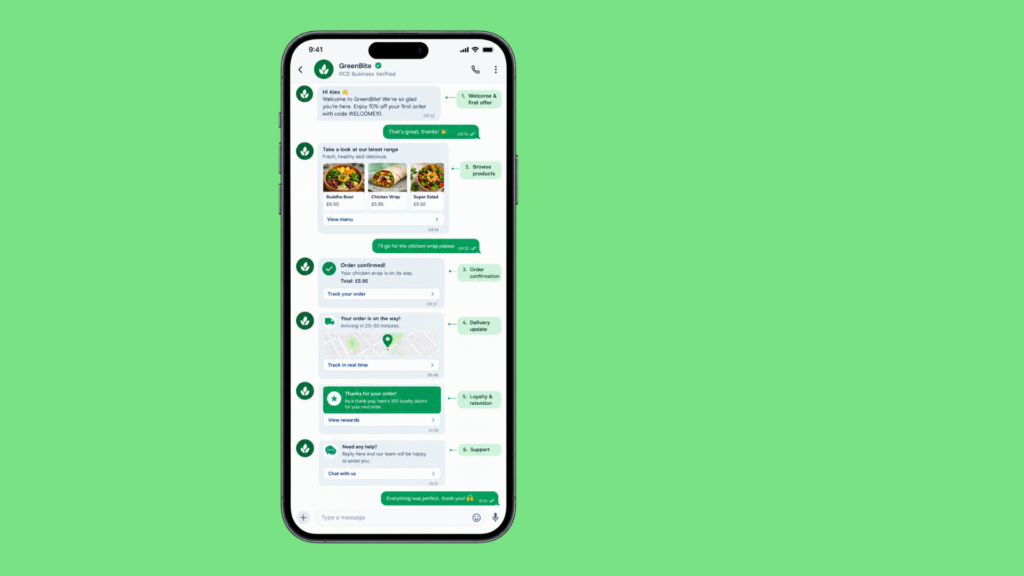
With RCS, your business gets a verified identity, so customers see your name and logo instead of an unknown number. You can add images, buttons and suggested replies, and the conversation carries on inside the same thread. A customer can discover you, choose a product, buy it, receive live updates, ask for help and come back later, all without leaving their inbox.
We like to call this reclaiming the thread. For years, businesses have handed customer conversations to email inboxes, third party apps and social platforms. RCS lets you take that space back, in the one place customers already check without thinking.
Isn’t RCS just a cooler version of SMS?
It’s a fair question, and the honest answer is: partly, but that’s the least interesting part.
SMS is brilliant at what it does. It’s simple, reliable and it reaches almost everyone. RCS builds on that foundation with richer formatting and two way interaction that feels closer to a chat than a broadcast. If you only use it to send a nicer looking version of the same promotion, then yes, it’s a cooler SMS.
The difference appears when you design the conversation around the customer’s next step. Buttons replace typing. Suggested replies replace guesswork. A verified sender replaces doubt. That shift from message to journey is where RCS stops being cosmetic and starts being commercial. It’s also why many businesses will keep SMS in the mix alongside it rather than choosing one or the other.

One thread, not separate campaigns
Most businesses treat these activities as separate pieces of marketing or customer service, often owned by different teams and delivered through different tools:
- Discovery through Google Search or an outbound message
- Guided product choice using questions, rich cards and suggested replies
- Purchase, booking or app download
- Order updates and customer support
- A personalised follow up or reorder in the same conversation
When they sit in one thread, the customer never has to start again. There’s no new app to download, no fresh password to remember and no old email to dig out. Your business stays visible as a verified conversation they can return to whenever they need you.
It also helps your team. Each stage informs the next, so the follow up can reflect what the customer chose, asked or bought earlier. That’s a far stronger foundation than a blast to a list.
What can RCS really do?
Put simply, it can guide someone from curiosity to purchase without ever making them leave the conversation. A customer might tap a button to browse a range, answer a couple of quick questions, view a tailored recommendation and confirm their choice. Afterwards, the same thread can share a dispatch update, offer help if something goes wrong and suggest a sensible reorder when the time is right.
Beyond rich media, the value shows up in fewer steps, clearer decisions and a relationship that doesn’t reset after every sale.
A guided gift finder in action
Want an example of where RCS is heading? Here’s the future of business to consumer messaging to show how this could work.
Picture a retailer heading into a busy gifting period, when customers are short on time and often unsure what to buy.
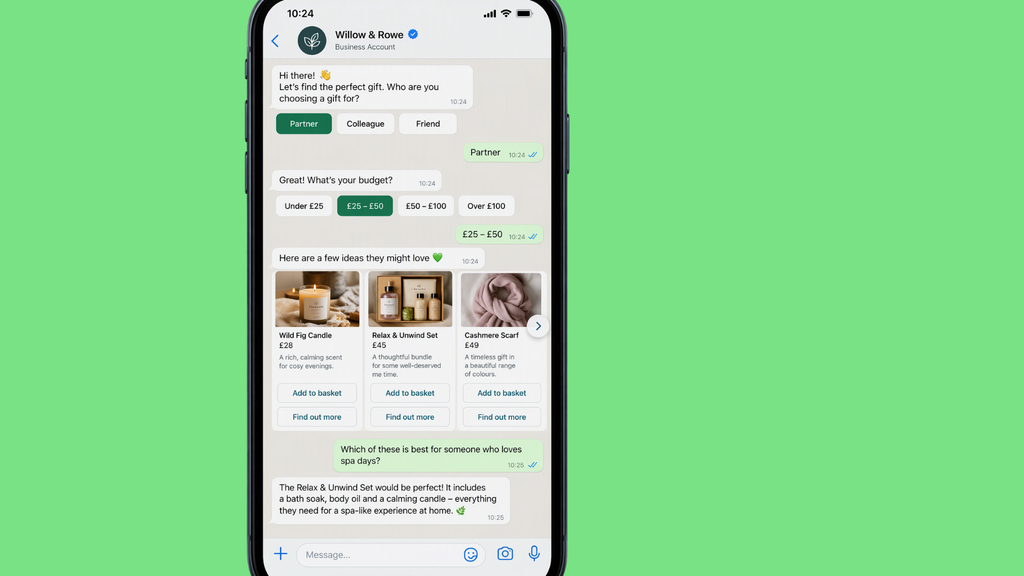
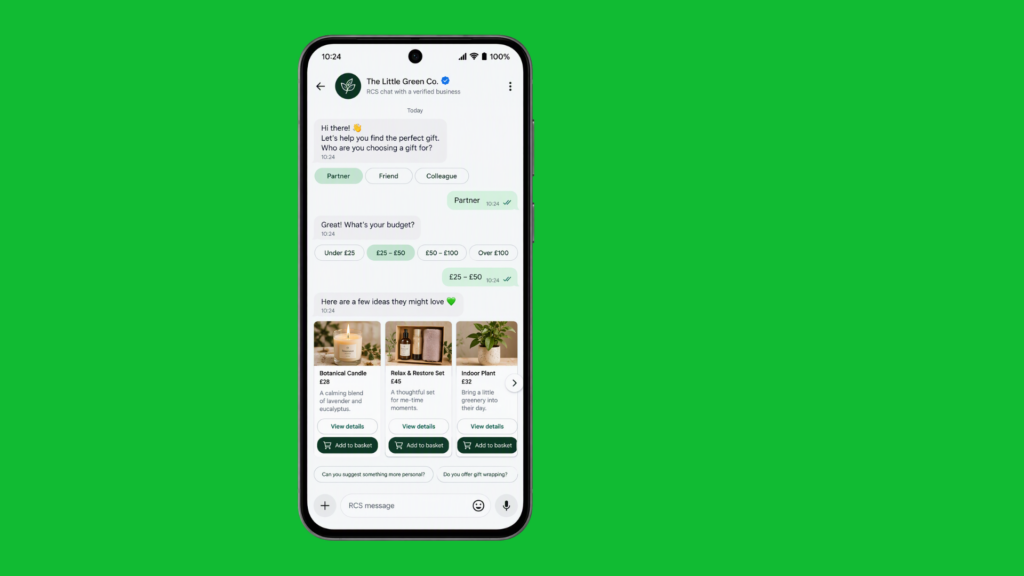
A customer opens a message and is asked a simple question: who are they choosing a gift for? They tap a suggested reply, such as a partner, a colleague or a friend, and then pick a budget. The conversation responds with a small selection of ideas in a carousel, each with a button to find out more or add to a basket. If they’re still undecided, they can ask a question and get a helpful answer rather than a wall of products.
Because everything happens in one thread, it feels like a friendly conversation rather than a scroll through a catalogue. The customer can move towards a purchase without leaving the message, and the business learns exactly what they were looking for.
Can a customer buy a product through a text message?
Yes, in practice they can. A button within an RCS message can take a customer straight to a checkout, a booking page or an app download, with their choices already carried across. The customer doesn’t need to search for the product again or work out where to go next.
How much of the transaction happens inside the conversation itself depends on how your journey is built and the tools you connect. Even so, removing unnecessary steps between “I like that” and “I’ve ordered it” is where much of the commercial value lies. Every tap you save is one less chance for someone to drift away.
Why generic messages still fall flat
It’s tempting to think rich media does the hard work for you. It doesn’t. A generic promotion presented in a carousel is still a generic promotion.
The stronger results appear when the conversation helps the customer decide, responds to what they tell you and removes friction along the way. Ask a useful question. Use the answer. Show something relevant rather than everything you sell. Think of RCS as a way of listening at scale rather than shouting more attractively.
Which data should you track?
Delivery, read and click rates are a good start, but they only tell you that people noticed your message. They don’t tell you whether it worked.
The better questions are these. Did the journey increase conversion? Did it raise average order value? Did customers buy again? Did they stay with you for longer? And crucially, did all of that happen profitably once you account for the cost of running it?
Wherever possible, give every campaign an SMS comparison or an A/B test. Running the same offer through SMS and RCS, or testing two versions of a journey, gives you honest evidence of what the richer experience adds. It also helps you decide where RCS earns its place and where a simple text is perfectly good enough.
The future of RCS
As support for RCS grows across devices and networks, more customers will be able to receive these richer conversations natively, without needing anything extra installed. Apple’s decision to support RCS on iPhone has been a significant step in that direction, and it makes the channel far more practical for businesses reaching a mixed audience.
We expect the businesses that benefit most to be the ones that treat RCS as a customer journey rather than a message format. The strongest proposition begins with discovery, helps the customer choose, moves them into a transaction, supports them afterwards and creates the next reason to return. Businesses that plan for that full loop now will be well placed as adoption continues.
Ready to reclaim the thread?
RCS works best when it’s designed around your customer’s whole journey, not just the send button. If you’d like to explore what a verified, conversational journey could look like for your business, our team can help you plan it, test it against SMS and measure what really matters.
Visit our RCS for business page or get in touch with Text Management today to start the conversation.